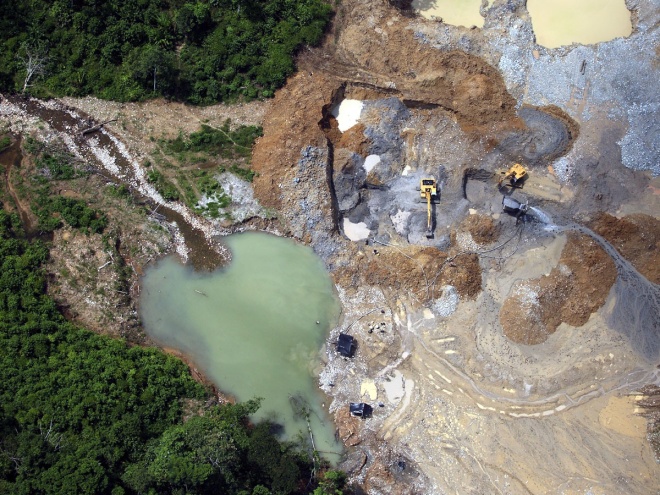
Deforestation is an urgent and direct threat to the world's ecosystems, climate and humanity. This section sets out the causes of deforestation, its scale, and its consequences - for wildlife, for climate, and for people.

How much rainforest is lost each year / each day?

The world lost a record 6.7 million hectares of tropical primary rainforest in 2024, an area almost the size of Panama, as per satellite imagery research from the University of Maryland's GLAD Lab and Global Forest Watch. This averages at the area of 18 football pitches of primary forest lost every minute. This was 80% more deforestation than 2023, and the highest figure recorded in at least two decades of satellite monitoring.

For the first time on record, in 2024 fires (not agriculture) were the leading cause of tropical primary forest loss, accounting for nearly 50% of all deforestation (GFW). The remaining loss was driven mainly by agricultural clearance and logging; despite global commitments to reduce deforestation, tropical forest loss from non-fire human drivers actually increased by 14% from 2024 to 2023.

Globally, total tree cover loss across all forest types reached 30 million hectares in 2024, an area roughly the size of Italy, the highest on record since satellite monitoring began. The fires responsible for much of this loss emitted 4.1 gigatons of greenhouse gases globally, more than four times the emissions from all air travel in 2023 (Mongabay).

Latin American rainforests suffered particularly badly in 2024. Brazil (home to more tropical forest than any other country) saw wildfires cause six times more forest loss than in 2023, as an extreme climate-change exacerbated drought made fires more intense and harder to control. Nicaragua had the highest percentage of primary forest loss of any country in 2024, at 4.7%, with nearly 78% of loss occurring in the Bosawás Biosphere Reserve

Of the 20 countries with the largest areas of primary forest, 17 have higher primary forest loss today than when the Glasgow Leaders Declaration on Forests and Land Use was signed in 2021 (to halt and reverse forest loss and land degradation by 2030). To eliminate deforestation by 2030, tropical forest loss would need to have been down to around 3.6 million hectares in 2024, not the recorded 6.7 million. To secure a biodiverse future with a healthy forested ecosystem, humanity is moving in the wrong direction.

Rainforest Concern is actively fighting deforestation and the loss of biodiversity. Over the last 32 years, Rainforest Concern has been instrumental in protecting 2.2 million hectares of threatened forest.

How much of the world's rainforests have been destroyed?

In the last century alone, Earth has lost one sixth of all its forests. Today forests cover 4.14 billion hectares, approximately 32% of the global land area (FAO's Global Forest Resources Assessment, 2025). Since 1990 an estimated 420 million hectares of forest have been lost to deforestation globally, according to the FAO's Global Forest Resources Assessment (2020). Tropical forests are around 45% of Earth’s total forest, but they are also the most heavily pressured; more than half of the world's tropical rainforests have been destroyed since the 1960s. Despite some decrease in overall deforestation rates, 2024 saw a record-breaking loss of 6.7 million hectares of tropical primary rainforest in a single year, the highest since satellite monitoring began.

Forests are not all of equal biodiversity, conservation or ecological value. When primary rainforest is lost, its biodiversity, soil complexity, and ecological relationships (each built over millions of years) are lost with it. The only certain way to prevent primary rainforest from joining the 420 million hectares lost since 1990 is to protect it before it can be deforested. Rainforest Concern focuses on protecting particularly rare and biodiverse forest types, for instance the Ecuadorian tropical cloud forests of the Neblina Reserve and the araucaria forest of Nasampulli.

What are the effects of habitat loss?

When a species’ habitat is destroyed, that species is forced to move, adapt, or go extinct. Deforestation is happening faster than most species can adapt, and due to habitat fragmentation it can be impossible for them to move - the trend is towards extinction. Deforestation has already caused extinctions and subsequent ecological cascades. Habitat loss and degradation are identified as the main threat to 85% of all species on the IUCN Red List classified as Threatened or Endangered (IUCN, Red List Update/Press Release). The consequences of deforestation extend far beyond wildlife: humanity depends directly on functioning ecosystems for food, clean water, medicine, and a stable climate. Therefore the destruction of habitat is simultaneously an ecological, economic, and human crisis.

In the study of extinction dynamics, Jarod Diamond’s ‘Evil Quartet’ describes the four principal mechanisms of extinction: overexploitation, alien species, habitat destruction and linked extinctions (i.e. when one species goes extinct, one dependent upon it follows). Of these habitat destruction is now (and is likely to continue to be) the single greatest driver of extinction globally. The IPBES Global Assessment, a metareview of 15,000 scientific papers, found that approximately 1 million plant and animal species are currently threatened with extinction, at a rate tens to hundreds of times higher than the natural background rate.

Landscapes are rarely deforested in one stroke; deforestation drivers normally fragment forest into increasingly small and isolated patches. As natural areas shrink into islands surrounded by farmland, infrastructure, and urban development, species populations become too small to be genetically viable, too isolated to migrate or adapt, and too exposed to edge effects that penetrate from surrounding land uses. Only one quarter of land areas and one third of oceans now remain relatively undamaged by human activity according to IPBES Global Forest Watch; for most species, movement to undisturbed habitat is impossible.

The effects of habitat destruction on human populations is severe at local and global scales. Land degradation has reduced the productivity of 23% of the global land surface and $235-577 billion in annual global crops are at risk from pollinator loss (IPBES 2018, 2016). The destruction of rainforest habitat eliminates ecosystems that generate rainfall and store carbon. Indigenous and rural communities are particularly severely affected by deforestation: for the estimated 1.5 billion people worldwide whose livelihoods depend directly on forests (including for food, medicine, shelter, and cultural identity) deforestation is not an abstract concept, it is an immediate existential threat that can arrive overnight in the form of illegal logging, wildfire, or forced displacement (FAO, State of the World's Forests 2022).

What is the link between rainforest destruction and climate change?

Tropical forests store an estimated 250 billion tonnes of carbon in their trees alone (Hubau et al., Nature, 2020). When rainforest is burned or cleared, its stored carbon is released into the atmosphere. In 2024, fire-driven degradation across the Amazon released 791 million metric tonnes of CO₂ (Bourgoin et al./European Commission Joint Research Centre, 2025). These Amazon fire emissions exceeded the annual fossil fuel output of most individual nations. Deforestation currently releases approximately 4.2 billion tonnes of CO₂ annually, roughly equal to the EU's entire fossil fuel emissions (Global Carbon Budget, 2024). The effect is cyclical: climate change has made the Amazon up to 30 times more prone to fire (Jones et al., Earth System Science Data, 2024), leaving it vulnerable to further deforestation by fire and carbon release. Evidence shows that compounding drought and deforestation could push the Amazon past a tipping point at which large sections permanently transition to savannah (Flores et al., Nature, 2024). Rainforest protection is therefore among the most powerful climate interventions immediately available. Brazil's approximately 50% reduction in Amazon deforestation in 2023 drove a 12% fall in national emissions.

The feedback dynamic is measurable and accelerating. Rainforest being more prone to fire due to climate change leaves it vulnerable even where deforestation rates fall. The consequences of crossing a tipping point would extend far beyond the Amazon basin. Should large parts of Amazonia permanently transition to savannah, the resulting carbon release and removal of the Amazon Rainforest's role in the water cycle would alter weather patterns across South America, threatening agricultural productivity and water supplies for hundreds of millions of people (World Economic Forum). The 1.5°C Paris Agreement target, already under pressure, would become unachievable.

We must work together to conserve as much rainforest as possible, to slow and counter both the biodiversity and the climate crises.

Closeui-chevron-nextui-chevron-prev