
Leafy background

Protecting Freshwater Turtle Nesting Beaches in Brazilian Amazonia - September Update

Our partnership project with Instituto Juruá and River Juruá rural communities to protect Amazon freshwater turtle nesting beaches is well underway.

The video above shows turtle mothers waiting at the foot of a protected River Juruá beach for the ideal moment to climb the beach, dig their nests and lay their eggs. This beach is protected as part of our project and we thank Instituto Juruá for the video clip.

Our project supports local communities in protecting the beaches along the main course of the Juruá, the natural nesting sites of three species of freshwater turtles; the giant Amazon River turtle (Podocnemis expansa, IUCN - Conservation Dependent), yellow-spotted river turtle (P. unifilis, IUCN Vulnerable [VU]), and six-tubercled Amazon River turtle (P. sextuberculata, VU).

Juruá Turtle Beach Mothers image2026
Amazon river turtle mothers wait below a sandy beach of the Juruá.

Photo: Instituto Juruá

Jurua turtle nest
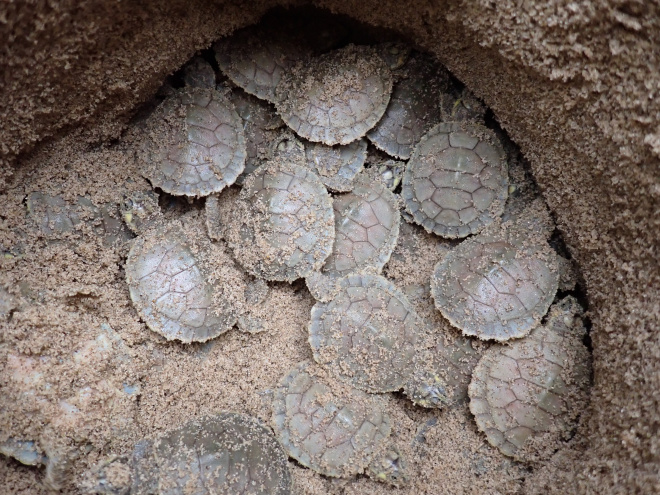
An Amazon river turtle nest

This nest was excavated to assess the health of the hatchlings. They were released directly into the river afterwards so as not to artificially expose them to circling vultures. Photo: Xavier Tobin

Unprotected Juruá beaches have extremely low turtle hatching success rates; it is normal for 99% of nests to be raided. It is fantastic to see so many turtle mothers laying on the protected beaches.


Working with local communities, this project will bring protection to ten currently unprotected beaches. As each beach can host hundreds of nests, which each nest holding roughly 100 eggs, over the coming years our project will lead to hundreds of thousands of additional hatchlings reaching the river. New communities are being approached about joining the project and turtle mothers are currently laying their eggs on existing protected beaches.

Above: Thousands of Amazon river turtle hatchlings sprint across a protected beach to the waters of the River Juruá.
Video: Instituto Juruá

Groundnesting turtlebeaches3
A black skimmer chick on a River Juruá protected beach

Photo: Hugo Costa, Instituto Juruá

The protection of the beaches has a broader effect than the turtles; many other animals use the beach too, for instance migratory birds.

This work is part of a larger conservation program that Instituto Juruá is growing, ensuring the alignment of biodiversity protection and improvements to local well-being. Over the coming decades this model can be expanded to other river-basins across the Brazilian Amazon, it is a landscape-scale conservation flagship project. We at Rainforest Concern are thrilled to be part of it.

Written by Xavier Tobin

Featured Articles

Closeui-chevron-nextui-chevron-prev